Spider Mites
Spider mites come from the family Tetranychidae, also classified as Arachnids, like spiders. Besides spiders, relatives to the spider mite include daddy-longlegs, ticks, and scorpions.
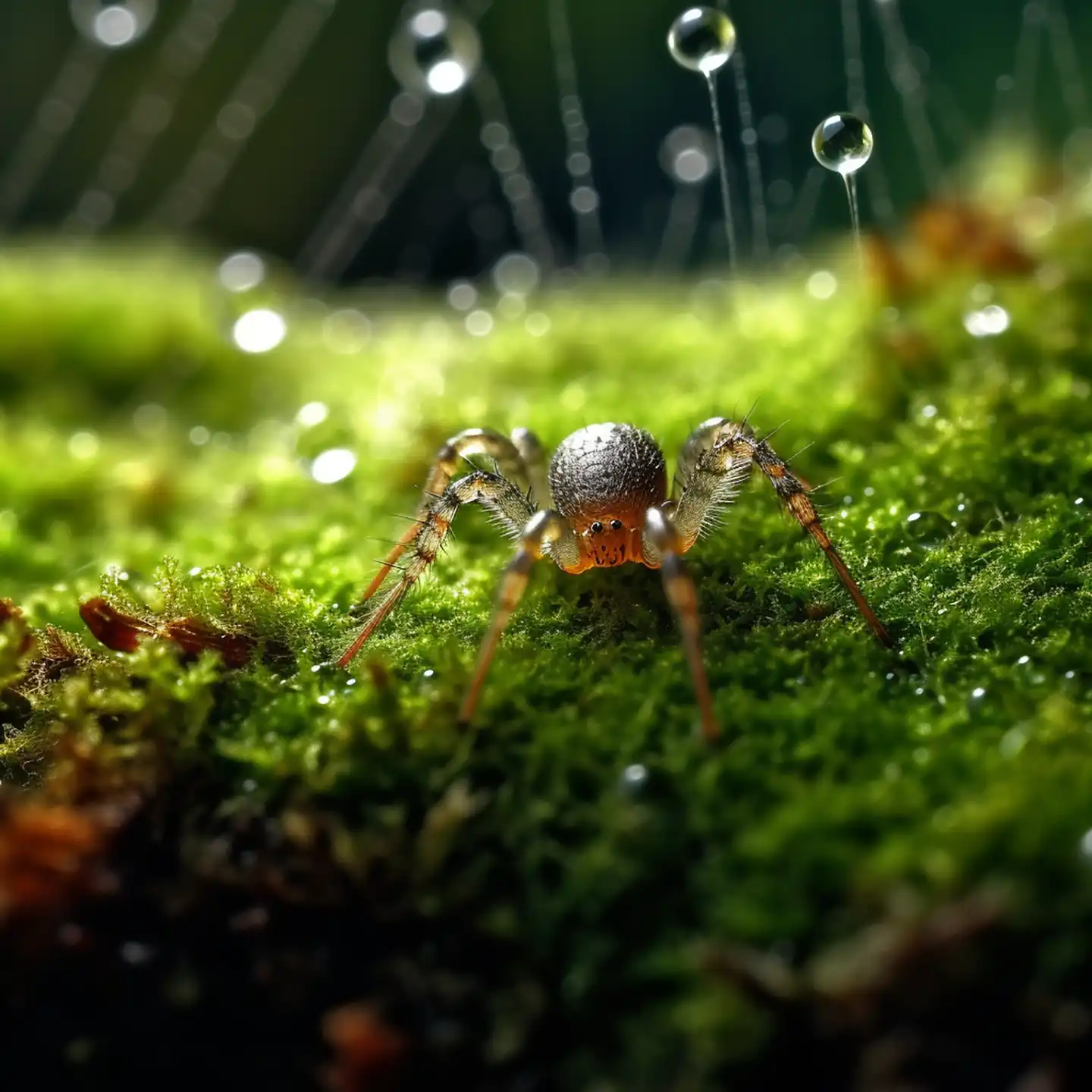
An up-close image of a spider mite with morning dew on plants.
Spider mites develop from eggs found near the leaf’s veins. Spider mite eggs are quite large, in fact, larger than the mother is. Spider mites are usually found in dry climates because they feed more under dry conditions.
Spider mites have eight legs and only a one-part body.
A spider mite alone is almost invisible to the naked eye; however, they can be seen in large groups. Also, when spider mites are in large groups, they can cause serious damage to crops and plants.
The mites have a pair of needle-like structures called stylets, which are used to split and break leaf cells. Spider mites push their mouth into the torn tissue and draw up the cell sap. The marks left on the leaf by the spider mite are quite noticeable due to the brownish or yellowish color. Quite often, the plant will die because of the damage caused by the spider mite.
Spider mites webbing can be easily confused with the webbing of a spider. A lot of spider mites produce their own webbing, especially when they occur in high populations. This webbing protects the mites and their eggs from their enemies.
The prime season for most spider mites is in the summer, and they can rapidly develop anywhere from a week or two weeks. For other species of the spider mite, the cooler seasons are their peak time. This includes the spruce spider mite and most mites that can damage turf grass.
Spider mites multiply!
It is important to check plants regularly to keep spider mites away from crops. The first sign of an infestation uses the lowest toxic treatment possible, creating a non-conductive environment for pests.
Spider mites, by themselves, generally do not move much farther than from leaf to leaf. However, other forces like bird feathers, animal hair, and clothes often move them.
Some common plants that spider mites include muskmelon, cantaloupe, beans, blackberry, cucumber, melons, and tomato plants. The damage on the plant leaves often looks like yellowish specks and fine webs, and the plant and fruit growth is stunted.
The spider mites have a few predators, including lady beetles, lacewings, and other mites. Spider mites do not bite human beings and are not a threat to anything other than plants and crops.
Dust Mite
Sometimes, spider mites are also referred to as Dust Mites. We have an entire post dedicated to Dust Mites.
i want to know what is biting me at night but only me and not my husband its really itchy and if i scrach it gets like a little bumb and a red but my matteres is new i got it in sears less then a yr ago have but bed bug spray baby power vacuumm my mattres watched all the blankets got new pillows and it still happening to the point i am afriad to go to bed dnt know what they are help
My mom got a spider bite on here butt she knew what kind it was. But we didn’t know how to take care of it we went to doc. So he mixed up this stuff looked and smelled like tar. She put it on and now its still not gone what do we do?????
3 years for me. It started with a bird feeder with bird mites and rodent mites! PCO’s have sprayed the yard but it really helped having an arborist to spray your trees also. My yard was loaded..spider mites, gnats u name it and I am the only person they bite! My dogs bring them in so I use revolution for them..the vet says it’s too bad I couldn’t use it! Oil your hair as much as possible…packing tape helps remove them off your body when you feel something move. Use lint rollers for bed, furniture and your car. DE has also helped. Comb out your hair in the shower to get as many out as possible.
Sometimes Dawn dish soap helps get them out..but then you have 2 oil your hair to replenish it. It sucks..thought I was getting close of ridding myself of these and them my head hit a plant before the respray of the trees! I looked at the leaves with my microscope and then..dammit! mites again in my hair! Stay away from yard work if you can! good luck to all..docs don’t really help and it’s hard to find any that knows about these things…don’t give up!
sincerely,
Jane
mine started three years ago with the bird feeder…nasty sulfur helped but no one can stand 2 be near you! I have a spider mite and bird..rodent mite problem..have seen both on my plants with my microscope. I have an arborist come out and spray all my trees and plants with AVID..it has helped but no guarantee! My dogs bring them in too from the grass.. no one else in family is affected. I smother oil in hair and body at night after I PACKING TAPE OFF MY BODY TO RID OF CRITTERS.
PACKING TAPE HELPS! Then use disposable shower cap at night. Wash hair with Dawn and really lotion up your body and hair to add oils again! Wish there was a cure for this! Maybe DDT back for spraying would help but illegal! good luck to all and pay someone to do your yardwork if you can! sincerely Jane
This is in response to Robert-spider mites do indeed bite. I have 15 bites on me that are anywhere from a quarter to half dollar size. They itch terribly. I went to the doctor and I got a cortisone shot-he also said to take zyrtec in the morning along with 400 mg of tagamet (there is a generic). Then in the evening take a bendryl and again 400 mg tagamet. Take cool showers, put ice on the really itchy bites. This worked wonders.
Spider mites DO bite! I have conducted my own ongoing experiment for over one year now. They may not bite everybody, but I have proven that some of us are very tasty hosts for them. I grow vegetation which requires daily maintenance and I have a very bad spider mite problem which requires constant attention. When tending my plants when no spider mites are present, I have no issues, bites or rash. EVERY TIME spider mites are present, I get bit all over my arms and they are nasty bites which last for weeks. They are small and look like flea bites. They itch so bad that it is nearly impossible not to scratch them open. I got on here looking for a treatment for the bites, as my left arm is covered with them as I type. Any suggestions to deal with the intense itching would be appreciated.
Here are some corrections or remarks to my comment of April 19, 2011: the right name of that alleged mind disorder is “Delusory parasitosis”. There is another frequent cypress tree pest, namely an insect, the Cinara cupressi (“pulgones negros”) and this might be whay I have the sensation I feel like 2 pests of different size: pest A is noted as bigger and bites skin here and there while crawling over and pest B is almost imperceptible and is only felt when a high level of pest population has invaded your mouth and you feel its needle sucking your moisture in tongue and throat. A lot of fun, really when you are suddenly woken up from your deep sleep at 4:00 AM and later again at 6:30 AM to give an example and this happens along the nights of 3 years, except 2 different nights I slept in a clinic because of operations. I have a shower and discontaminate all my dress and shoes when I get out of my dwelling and never have a sign of bite outdoors. Only when I enter back in the building. I learned the problem should be a pest after I saw a program on German SAT TV about house mites in mattresses, but my case is not this (I installed an ultrasound mite reject), but some arthropod related to cypress tree, although the ‘official’ doctrine does not recognize this fact yet.
So the official Health system adheres to the “Delusory Parasitosis” diagnosis (without giving any scientific evidence in their articles), which does NOT fit at all to the facts and situations I am observing, while my theory (the attacks are caused by Italian-type cypress tree) complies with all real situations applying ‘police’ method criteria. A clear example is that I have arrived to the same conclusion like Gloria, who is a lot of km apart overseas in USA. Curious thing is that doctors here refuse to order the collection of samples in my dwelling to confirm or not the presence of some pest also existing in cypress. So they prevent me to obtain a biologic scientific evidence on the correlation between cypress and those attacks in my humid areas. Even the ‘minister’ of Health in this Autonomous Region ignores my reports: he gives no response at all. Should I go to the Magistrates’ Court to get that judge order to investigate by this test in the way I suggest? How readers evaluate my ‘1001 Nights’ with that funny amusement in bed?
They do not care at all. Sorry, folks, pest is now filling my mouth and eyes, ‘snaling’ in/out my nose and I must get up and hurry to wash. This is the assistance one receives in SPAIN when my employers and myself have paid tax for my position running US and German corporations in Spain over 400,000 dollars at constant value to the Social Security along my working life creating jobs etc. …
I am Spanish and live near to Barcelona City. I have been suffering for 3 years now attacks by some agent (pest?), which loves my warm moisture in membranes like eyes, mouth, nose, ears etc. I have been corresponding with a US entomologist, who sent me an article on Delusory parasisosis. My systematic follow-up leads me to think a pest coming from a near Italian cypress tree has invaded my home. I read “Spider mites do not bite human beings”, but my sensation is like 2 different pests are present all round. I have prepared the report below and would like to exchange experiences with other ‘sufferers’ like Gloria. But she does not report attacks in the same body areas. Could anybody tell me how to get rid of these pests (obviously cutting down the tree, but it does not belong to me). Here is my text:
Good day. URGENT matter: please give priority
I have read the web of the TEXAS Forest Service and
found on it some valuable info related to my case.
Am located in a Summer resort South of Barcelona, Spain.
The problem has been + is I am attacked daily along the last 3 years by a yet unidentified pest every night in bed
and during the day when sitting at PC and watching TV,
right after the pest explorers have located me and this
happens mainly after I take my meals.
The Public Health institutions and political authorities in
Barcelona refuse, are not willing or unable to assist me. Cause likely is some authors have created some confusion to dermists and allergists alleging that sensations of beings crawling over skin of ‘sufferers’ are not real and pretending psychiatrists have the key for a presumed ‘mental disorder’ [¿?].
In my case I refute absolutely this non-scientifically enough proven thesis. With my systematic observations I only can accept there are some common areas: that may interfere a right diagnosis.
What I request is a serious investigation by a biologist, that
specifies the methodology to collect samples at my home and looks at them with a microscope. Identification is necessary and previous to pest control in my dwelling.
Am reproducing here as a SUMMARY a number of para-graphs of previous reports of mine, which am putting to your consideration kindly requesting you if you think my theory is plausible and consistent and can be confirmed by your experience or scientific background, as follows:
1.
Spider mites are common pests in the urban landscape. They can inflict serious damage to trees, shrubs and flowers. Both evergreen and deciduous plants may be attacked. Spider mites are not insects but are more closely related to ticks (garrapatas) and spiders.
2.
Many species of spider mites can be found in landscapes:
• The twospotted spider mite,
• Tetranychus urticae (Koch), and spruce spider mite,
• Oligonychus ununguis (Jacobi), are the most common pests.
Other species with fewer host plants include:
• European red mite,
• Panonychus ulmi (Koch), found on apple trees;
• honeylocust spider mite,
• Platytetra-nychus multidigitali (Ewing);
• southern red mite,
• Oligonychus ilicis (McGregor), on a variety of plants;
• boxwood spider mite,
• Eurytetranychus buxi (Garman); and the oak mite,
• Oligonychus bicolor (Banks).
•
3.
Types of Damage
Spider mites have needle-like mouth parts and feed by piercing the leaves of host plants to suck out the fluids from individual plant cells. Needle-like : como agujas, y
son las que se me clavan dentro de mi boca y garganta.
Besides, these pests absorb moisture from my eyes.
4.
They are even known to wander inside [emigran a los interiores] when numbers are abundant and walk about on counters and offices furniture [se pasean por los mostradores y muebles de oficina ]. They frequently enter computer equipment and appliances, apparently for the warmth [a menudo entran en los ordenadores y electrodomésticos, quizá buscando calor].
5.
The twospotted spider mite, for example, is often introduced on infested bedding and house plants.
Spider mites are usually not killed by regular insecticides (estos arácnidos están cubiertos -como yo pensaba- por una cutícula protectora) pero con mi defensa, 3 máquinas por medios físicos (vapor / aire HT), sí mueren.
Si no, me sería imposible dormir seguido unas pocas horas.
rev: 21.02.2011
6.
Mi teoría -pendiente por supuesto de ser confirmada técnicamente por la visualización de las muestras- creo es la más plausible y ello -sin descartar nunca otras hipótesis- simplemente porque las piezas me encajan prácticamente todas en el puzzle, como sigue:
I believe alleged X-pest could well be some very tiny beings, that are living specifically in the cypress growing (3-level up to the roof) in the garden located in the ground floor below.
We see now (pollen season) how dust + pollen clouds are blown off daily from the tree by local winds coming from the sea to my balcony with other ‘spores’ or tiny particles; pest units are likely thrown together in this mass too.
Now we must keep balcony + window of dining room closed all day thru, as we are in the very heart of pollen season.
US entomologists say cypress spider mites do not usually attack humans; maybe, I can only agree this pest is not purposely designed to live in humans, but in garden.
(The possible explanation is: no precedent is available, as nobody related before a cypress tree with those attacks:
I found this correlation by my investigations. Physicians
can not see from their desk in the hospital that we have a
cypress tree below in the garden and never found such a
situation in the past. My blame is I am saying all the time
there is here a pest and they did not undertake any action
either, even after I told them my story when I found the cypress as the pest source).
However, when they have landed in my balcony, they likely move crawling over the floor or suspended in air and try to enter in the human dwelling; once are inside our flat they search for higher temp and moisture rooms than outdoors.
When am in bed in the night, or standing or sitting a while, their ‘pioneers’ detect me as a tasty host, climb up to my mouth, eyes and nose to enjoy my body liquids. Therefore their attacks are not too relevant on my skin (only a couple of bites in ears and outside nose), used mainly as a surface for their transit; their real target are my mentioned areas, where they rest and bite fiercely to absorb humidity / membrane moisture.
The higher the pest population, the more intensive attacks until my biological alarm wakes me up [¿?] in bed.
My wife –as a lady- has realized a new factor in the day the Bolivian girl comes once a week to clean our staircase:
by design this is pretty dark, as has no daylight nor any windows: when she shakes doormats, pest is likely project-ted around on floor and air of all 3 landings and invades flat.
This might be too why I feel impacts of tiny masses on the head and eye invasion falling from upper floors when I enter the building from street.
Conclusión
I. The supposed pest is in the building where I live and at home including balcony, the gallery, where laundry is hung.
When my wife puts clean dry bedding, I have to kill pest with steam
II. I never noticed pest presence or attacks outdoors nor in the nights I have slept in Hospital bed in 2 different occasions
III. when I take papers from drawers, files, desk etc. I’m right away attacked in my eyes + mouth and so on
7.
My application to Health Authority
I. I request the responsible Health Authority to give specific orders to have this problem investigated to determine real cause and diagnosis and how to solve issue to get rid of pest or attacks
II. this should happen asap: I do not want to spend any further night waking up with my mouth and eyes full of sawdust (‘serrín’) and asphyxia feeling (asthma from mite feces?)
III. I want this cypress cut down immediately
Gracias y saludos
Dr. Ing. Francisco de Asís RUIZ
Economist (Faculty BCN) + Ingeniero Industrial
US Diploma as an Engineer on Power Transmission …
P.S.: please feel free to call back on me if you need further data or the sketch I have prepared for graphical issue representation as an attachment
Hi,
Could someone please tell me what is the difference between a Spider mite and a Red Poultry mite?
Thanks.
i have this bite that is big but it is red and it itches, my mom says it is not a spider bite. what do you think is? please tell me.
well it might be a bite from mosquitoes.
Do spider mites come at you with a double prong? I find that some of my bites have two holes very close to each other. What could that be?
I had a huge spider mite problem in my garden. I was recommended to a new product out of Colorado that worked amazingly well. I am passing the information on because one, I have personally used it and it is by far the best product I have ever used and two, when I have something that I believe and trust in then I pass the good news along. The product is No Spider Mites seen at www.NoSpiderMites.com . It was referred to me by a friend and has been just a blessing for my valuable crop.
I’ve been having a tiny biting bug issue since May. Termenex has treated my home several times, and they can’t identify them. Still they persist, any ideas what they could be, and how to get rid of them?
i got bitten by spider mites with a white-ish double triangle on its back sort of 2 pyramids with the points touching. I’ve started to feel sick and the pain started in my leg and ran up to my back and my eyelids have swollen. should i be worried! i’m gong for lay down.
Howdy,
I’ve got a spider mite issue and I was wondering, do they live away from the plants? What I’m needing to know, is if fogging the plants room, without any plants in it, would do me any good. Or do I just need to kill them on the plants only ?
Hey! I like am TOTALLY scared of spiders. Can anyone help me get over my fear?
~Lauren!
August 6,2010
Yes, spider mites DO BITE. A group of them were on some roses that a friend gave me. They spun a red web on some things in my kitchen, and while cleaning them up one bit me on my wrist. It was like a sting, and immediately began to form a blister about a 1/2 inch long. I iced it and later took an anti-histamine. 24 hours later the bite is crusting and I assume will heal without a hole in my wrist. the area around it is still red.
go to home depot or lowes or any nursery and pick up neem oil . Dilute it in a 10/1 ratio with water 10 parts water for 1 part neem , this is an organic way to kill the mites w/o harming the plants .
neem oil is derived from the sap of the neem tree in parts of india china ect . the oil is non toxic and can have a pleasant citrus smell .
I have been getting insect bite for about a week. I have them on my legs, arms, and my neck. I have checked my cat for fleas several times I don’t know what could be causing these bites or on how to stop whatever it is, please help!
My daughter was bitten by what I believe was a spider. 2 days after she was bit the swelling took place and looked like a tennis ball that was inside her back. Took her to the hospital and the doctor didn’t really do anything about her bite other than draw a pen mark around the swelling around the bite. He sent me home with an antibiotic prescription. It has been 4 days since she has started her medication, At first the bite was starting to look better but as I look at it again today it looks like it’s starting to swell again. I’m hoping by sending pictures that somebody can tell me if this in fact is a spider bite. Thank you.
Hi, my husband and myself visited a spa over the weekend, and while we were busy with the body scrub treatment, I felt a prick with light burning sensation on my leg. It started itching and I thought nothing of it but today, tree days later the bite mark is a huge red with light redness and very tenderness around the mark. When I walk i can feel some pain (like inflammation). Can it be a spider bite?
I highly doubt that you got bitten by a spider mite because they cant do something like that.
But anyways, thanks for the article helped me out!
I beg to differ with your statement that spider mites do not bite humans. I was bitten by one two days ago, and developed a spider bite blister. I know it was a spider mite, because I felt the bite and saw the mite on my arm. It caused a blister and hot area with a hard lump about the size of a quarter around the bite. A larger red area developed within 2-3 hours, about 3″-4″ across. I’ve applied ice packs and the redness and swelling have almost disappeared. There is still some heat around the blister area, and it itches like crazy.
i have a small spot on my calf less then a foot away from my knee. it is a light color more like a very light bruise. it dosent hurt its just wont go away. please tell me what should i do or what it may be so i can make it go away.
Thank you.
I found eggs in my house plant it is a typical hose vine and I believe it is spider mites how can I get rid of the without killing the plats and do I treat the other houseplants also.
Hello there, I would like to have information about spider mites and how we can control them biologically like are there any essential oils which are used to control the mites at farm level?