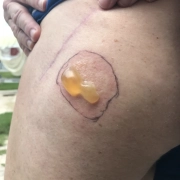
June 17th, 2007
You are currently browsing the articles from Spider Bites written on June 17th, 2007.
Did you know that in Florida, there are four types of Widow Spiders? They are the Northern Black Widow spider, the Southern Widow Spider, the red Widow Spider and the Brown Widow Spider which will discuss in more detail below. Although the venom of these spiders are not as toxic as the Black Widow, they are still very painful and can cause serious injury if not treated.

Because brown widow spiders (latrodectus geometricus) can vary from light tan to dark brown or almost black and may have differing markings such as white, black, yellow, brown and even orange on the back of their abdomen, they are very hard to recognize! The picture below is of the red widow spider.

On the bottom of the abdomen you’ll notice the hourglass marking but it will be colored yellow or orange. The Egg Sac of the brown widow spider is not that same as other widows and has pointed projections much like the old sea mines.
If you have pictures of this spider, or believe you have been bitten by a Brown Widow, please post your comments below and send the pictures to the email address located on the bottom of this page.
Written by Jim on June 17th, 2007 with 358 comments.
Read more articles on Mites and Spider Bites.
The Banana Spider is known to hide among bananas shipped to the US and is really called the Brazilian Wandering Spider. These spiders are aggressive and very venomous and not intimidated by size (can attack people when threatened).

The odd part about the Banana Spider is that studies indicate only 33% of the spider bites actually contain any significant amount of venom, but those that are injected with venom could be in serious danger!
If you are bitten by a Brazilian Wandering spider (Phoneutria spp.), you should seek immediate emergency treatment as the venom could possibly be life threatening. The Phoneutria not only has a potent neurotoxin, but is said to have one of the most excruciatingly painful spider bites of all spiders due to its high concentration of serotonin.
Despite the Banana Spider’s reputation as the world’s deadliest spider, there are multiple studies that dispute the ability for the spider to actually kill a human and one study suggested that a little over 2% of these spider bites (mostly in children) were serious enough to require antivenom.
On the other hand, there are other studies suggesting that the Banana Spider is indeed the most toxic spider in the world based upon toxicology studies. One of the most notable and thorough studies is presented in the book “Venomous Animals and their Venoms Vol. III” by Wolfgang Bucheral and Eleanor Buckley. This study has some shocking findings that clearly demonstrate how lethal the Brazilian Wandering spider can actually be.
There is an antidote for the bite of a Banana Spider and was discovered by Carlos Chagas from Brazil.
If you see a spider hiding in a cluster of Bananas, you should move right along and possibly inform the store manager that is may be a Banana Spider!
Written by Jim on June 17th, 2007 with 92 comments.
Read more articles on Spider Bite Pictures.
What is Lyme disease?
If you have a bulls-eye rash and possibly a fever, headache or muscle pain, then you may have Lyme Disease. Believe it or not, it’s caused by a mouse, but not like you would think. The mouse has Borrelia burgdorferi (boar-ELL-ee-uh burg-dorf-ERR-eye) and is bitten by a tick that then bites you. These ticks are very small and very hard to see.
The Bulls eye rash that appears around 7 to 14 days doesn’t always happen and some people can still have the flu like symptoms that can come with Lyme disease.
It is important to get medical attention and without it, the bacteria can makes its way into the entire body that could cause rashes that appear in areas never bitten by the tic. If not treated, pain, swelling and mood changes can occur months after being bitten!
Preventing Lyme Disease
- Avoid entering areas that are home to ticks in the spring and summer months.
- If you are in a tick infested area, wear clothing that is lightly colored which will help you spot ticks. Also, make sure your entire body is clothed and that skin is not exposed.
- Bug spray that contains DEET (n,n-diethyl-m-toluamide) can be applied to clothes and exposed skin.
- You can use Permethrin on cloths which kills tics dead (and fast) but make sure not to come in contact with skin.
The photo to the left is of the Ixodes Tick which is classified as a hard tick, due to the presence of a dorsal plate.
If you find a tick embedded into your skin, use teasers and pull straight out. Be sure not to twist as you pull or part of the tick’s body could end up inside your skin and cause an infection. After you have removed the tick, clean the area with antiseptic.
Ticks love foliage such as leaf piles (I know, children love to play in them, but so do ticks!). They can also be found in piles of wood, such as those we use for fire, etc.
If you discover a tic embedded in your skin, make sure to watch that area and be area of flu-like symptoms. If you think you may have Lyme disease, let your doctor know and they’ll be able to tell you for sure.
Written by Jim on June 17th, 2007 with 33 comments.
Read more articles on Infection.