What Bit Me? Identify a Bite by Its Pattern
Most bites look alike up close: a red bump that itches or hurts, with the bug long gone. What separates them is the pattern. How many marks there are, how they are arranged, what grows around them, and what happens over the next day or two tell you more than the bump itself. This page sorts the patterns readers have sent in over sixteen years and points you to the page that covers each one in depth.
One rule comes before the chart. If a bite is getting worse after a day or two, is hot or oozing, has a red line running away from it, or comes with fever or muscle pain, see a doctor. Readers here have learned that the hard way more often than they have learned which spider it was.
The Bite Pattern Chart
| What you see | Most likely cause | Where to go next |
|---|---|---|
| Several bites in a straight line or a tight row, found after sleeping | Bed bugs; fleas if the bites sit low on the legs | Bed bug vs spider bite |
| One bite with a red line or streak running toward the armpit or groin | Infection spreading along the lymph vessels | Spider bite treatment |
| A sore that grew for days, hot and painful, with pus or a dark center | A staph or MRSA skin infection; rarely a brown recluse bite | MRSA, brown recluse bite |
| A ring that keeps widening, often with clearer skin in the middle | A tick bite with the Lyme rash; ringworm | Lyme disease rash |
| Two tiny puncture marks close together | Possibly a spider, but readers’ two-dot bites have turned out to be infections too | Spider bite pictures |
| Pain spreading from the bite into the chest, belly or legs, with cramping or sweating | Black widow | Black widow bite |
| A cluster or band of blisters on one side of the body, tender or burning | Shingles, which is a virus and not a bite | Shingles |
| Pimple-like bumps that itch hardest at night, between the fingers or at the waist | Scabies | Scabies |
Bites in a Row
Bed bug bites look much like mosquito or flea bites: a slightly swollen red spot that may itch. The CDC notes the marks can be random or in a straight line, that they show up on skin left bare in bed such as the face, neck, arms and hands, and that they can take from a day to two weeks to appear. Some people never react at all. Flea bites favor the legs and the places clothes fit tight, and often come three bumps together.
L.A., who had been through an infestation, listed the clues for another reader. Bites in a row or a cluster that itch harder than a mosquito bite. Dried brown blood dots on the pillow and sheets. Dark streaks on the bedding that looked to her like splattered mascara. A sickly sweet smell in the room. The bugs themselves are thin, fast and only out at night, which is why most people find the clues before they find the bug.
Our bed bug page covers how a bed bug bite differs from a spider bite and where to look for the bugs.
A Red Streak Running From the Bite
A red line running from a bite toward the armpit or groin means bacteria have reached the lymph vessels. MedlinePlus lists those streaks, which can be faint or obvious, along with throbbing pain, fever, chills and tender lymph nodes at the elbow, armpit or groin, as the signs of lymphangitis. It says the infection can spread within hours and that treatment should begin right away. Strep is the usual cause, staph less often. The bite is only the doorway. Scratching it open with dirty fingernails is one of the commonest ways bacteria get through it.
Amie in central Florida scratched a deer fly bite on her ankle before washing the potting soil off her hands. By the next morning the bite was hot, painful and the size of a silver dollar. The first emergency room visit sent her home with antibiotics. The second, when it kept getting worse, added a blood test and a stronger antibiotic by injection. Her rule afterward: a bite you have cleaned and covered should not get worse over the next day or two, and if it does, it needs a doctor rather than another day of waiting.
The spider bite treatment page covers first aid and the signs that an infection is taking hold, and the staph infection page shows what infected bites look like from day to day.
A Sore With a Dark Center That Keeps Growing
A bump that is red, swollen, painful, warm and full of pus describes a staph skin infection, MRSA included, far more often than it describes a spider bite. The CDC says people sometimes confuse MRSA skin infections with spider bites, and that unless you actually saw the spider, the sore is probably not a bite. You cannot tell MRSA from other staph by looking. It advises contacting a healthcare provider, especially with a fever or if the sore has not improved within 48 hours, and never picking at or popping it.
The one spider in the United States that can cause an open sore is the brown recluse. MedlinePlus describes the bite as a sharp sting or nothing at all, pain developing within the first several hours, sometimes a blood blister with a bull’s eye look, and in serious cases black tissue that sloughs off after two to five weeks and leaves an ulcer. A suspected recluse bite is a reason for the emergency room right away. It is also far rarer than infection, and only possible where recluses live.
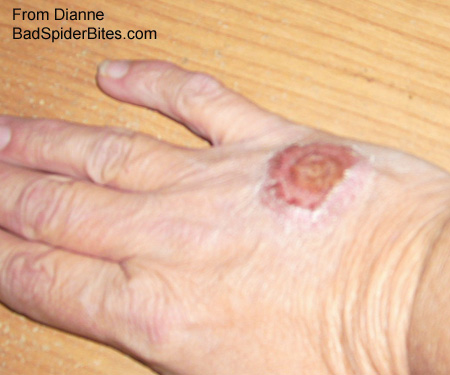
Dianne in Texas started with a tiny spot that had a black dot in the middle. It grew to the size of a half dollar and hurt badly, with every symptom she had read about for spider bites. The emergency room called it a bacterial infection and prescribed antibiotics, her own doctor added a steroid course, and the sore stopped growing.
Mandy in central Ohio found what looked like a pimple above her knee, with two puncture marks under it and redness that spread to the width of a coffee mug in three days. Two days after she posted, she came back with the diagnosis: MRSA. Her note to everyone with the same symptoms was to go to the doctor immediately.
See the MRSA page for what these infections look like at each stage, and the brown recluse bite page for the real thing, including where the spider does and does not live.
A Ring or Bullseye
The rash of early Lyme disease starts at the tick bite 3 to 30 days later, about a week on average, and widens over several days to as much as 12 inches across. The CDC says it is rarely itchy or painful, may feel warm, and does not always form the classic bullseye. About 70 to 80 percent of infected people get it. Not every ring is Lyme. Readers have also mistaken ringworm, a fungal infection that spreads outward from a center that can pass for a bite, for a spider bite.
Carol noticed several bites on her thigh and the back of her knee after gardening in a wooded area with deer, two of them with a bullseye look. By the next day the redness on those two was spreading in a circle and itching far worse than a mosquito bite. Her doctor treated the reaction and ordered a Lyme blood test timed four weeks out, because the antibodies take that long to build. Her advice to other readers: anything that behaves worse than a mosquito bite deserves a trip to the clinic.
Rosalie, a microbiologist, wrote in because another reader’s spreading bite sounded like the start of her own ringworm: a mosquito-looking spot that spread larger and faster than an infected bite should, with a center that looked like a bite. She had been in a house with ringworm the day before. Her point was that her doctor had not seen it either, so tell yours where you have been.
The Lyme disease page shows the rash in photos and explains the tick bite behind it.
Two Tiny Puncture Marks
Two dots side by side are the detail readers lean on most and the one that settles least. NIOSH lists two puncture marks as a feature of black widow bites, but the readers who sent in two-dot bites got every kind of answer. Chelsea in northwest Louisiana woke to a sharp pain, found two small punctures on her arm, and watched the area swell to four inches by morning. One doctor called it a venomous bite, a second said it might be a reaction to something harmless, and neither could name the culprit. With antibiotics and a steroid, the swelling and redness had gone down three days later. A mother whose seven-year-old was sent home from school with a swollen elbow, two fang-like marks and red blotches went straight to the emergency room on the pediatrician’s advice. The ER could not identify the bite either and treated it with antibiotics. Mandy’s two punctures, above, were MRSA.
Two marks tell you something broke the skin. What happens in the next 24 hours tells you whether it matters. The spider bite pictures page has the chart that sorts bites by spider, for the times you did see one.
Pain That Spreads, With Cramping or Sweating
A black widow bite often starts as a pinprick, and some people feel nothing. MedlinePlus describes a dull muscle pain that spreads from the bite after 15 minutes to an hour, felt mostly in the chest for bites on the upper body and in the abdomen for bites lower down, with cramping, sweating, nausea, headache and high blood pressure in the hours that follow. It says to get medical help right away. Severe symptoms usually begin to ease within two to three days.
Robin walked through a series of webs in the dark at a barbecue in Hutto, Texas. Over the following hours she was exhausted, then nauseated, then her left calf went into spasms and her throat felt swollen, and she explained each one away until the bite itself began to itch and scratching it set off severe pain. The bite had two puncture marks and an odd horizontal bruise. At the emergency room she had high blood pressure, fever, sweating and chills. The doctor could not name the spider that early, and the swelling and most of the symptoms were gone in four days.
The black widow page covers the bite hour by hour and the reader reports behind it.
A Cluster or Band of Blisters on One Side
Shingles is the look-alike readers have caught for each other most often. The CDC describes a rash that most commonly appears as a single stripe on one side of the body or face, made of blisters that scab over in 7 to 10 days, often with pain, itching or tingling in that spot for several days before anything shows. Over the years at least six readers wrote in to tell another reader that the spider bite in their photo looked like shingles, and one of them, Deb, confirmed that her own identical spots had been diagnosed as exactly that: red dots that became white bumps and then filled with pus.
The shingles page shows what it looks like and why it gets mistaken for bites.
Itchy Bumps That Are Worst at Night
Scabies mites cause intense itching, especially at night, and a pimple-like rash between the fingers, in the folds of the wrists, elbows and knees, and around the waist, according to the CDC. The burrows look like tiny raised, crooked lines, grayish or skin colored. First-time symptoms take several weeks to appear after contact, and it spreads by prolonged skin-to-skin contact, so a household that itches together is a strong clue. Readers describing weeks of night itching, new bumps appearing, no bug ever found, and family members with the same complaint are usually describing mites, not spiders.
The scabies page shows the rash on the neck, arms and legs and carries Amber’s account of her baby’s rash, which took a skin scraping at the doctor’s office to name. If you suspect spider mites, our spider mites page explains what those plant feeders actually do to skin.
When to See a Doctor the Same Day
- A red streak running from the bite, or redness that spreads by the hour
- A sore that is hot, oozing or turning dark, or any sore that has not improved after 48 hours
- Pain spreading away from the bite, muscle cramps, sweating or trouble swallowing
- Fever, chills or feeling sick along with the bite
- A widening ring after time outdoors in tick country
- Any bite on a small child that is swelling fast
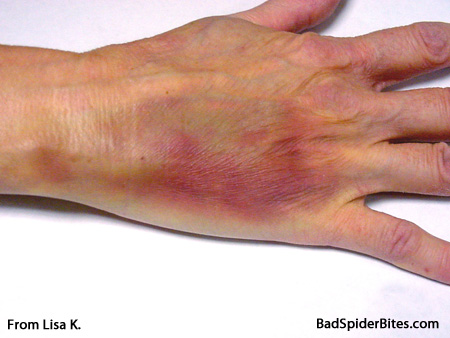
Speed matters even when nobody ever names the bug. Lisa in southeast Florida reached into a cabinet under her sink, and within minutes the back of her hand had swollen, turned blue and begun to hurt. She was in an allergist’s office two hours later and on a short course of prednisone that afternoon. Nobody ever identified what bit her. The speed of the reaction was the reason to go, and it was the right call.
Where the Cases Come From
This page used to be the site’s photo submission form, and that service is closed. The archive it built, more than seven hundred reader reports on this page alone, is where every case above comes from, with names shortened and dates left off. If you found the spider, start with the spider identification guide. If you only have the bite, the reader bite reports archive has hundreds more photos to compare against.