House Spiders: Which One Is in Your House, and Does It Bite?
“House spider” is not one spider. It is the name people give to whatever they find in the corner of the ceiling, under the basement stairs, on the bathroom wall or in the bottom of the tub. In the United States it usually means a small cobweb spider. In Britain and the Pacific Northwest it usually means a large, long-legged funnel weaver. In Australia it means a dark spider in the window frame. This page sorts out which one you have, which ones only look like house spiders, and what a bite from any of them means, using reader photos from this site’s identification thread and the university and museum pages that describe each species.
One idea from the Burke Museum’s spider myths pages reorganizes the whole subject. The spiders that live in your house are usually not the same species as the ones in your yard. They are a small number of species adapted to indoor conditions, some of them living in buildings since Roman times, and they colonize a new house as egg sacs carried in on furniture and building materials. The museum puts it as generally fewer than 5 percent of the spiders you see indoors having ever been outdoors. They do not come in to escape the cold. The late-summer surge most people notice is the mating season, when mature males wander in search of females while the females stay hidden in wall voids, crawl spaces and storage.
The House Spider Chart
| What you see | Which spider | Where in the house | Where to go next |
|---|---|---|---|
| Small, drab, round-bodied spider in a messy tangle web, with papery brown egg sacs | Common house spider (American house spider) | Corners of walls and windows, basements, crawl spaces, garages | Common house spider section below |
| Large, hairy, long-legged brown spider on the floor or in the tub, flat sheet web with a funnel | Giant house spider or another funnel weaver | Basements, garages, floors, sinks and bathtubs | Giant house spider section below |
| Tiny pale body on extremely long thin legs, bounces in its web when touched | Cellar spider, the daddy longlegs spider | Cellars, ceiling corners, behind doors, garages | Cellar spider section below |
| Charcoal-gray spider with a flat, woolly, debris-filled web spreading from a crevice | Southern house spider | Window sills, shutters, overhangs, masonry in the South | Southern house spider section below |
| Dark, heavily built spider in a lacy web with funnel-shaped entrances around a window frame, in Australia | Black house spider (window spider) | Window frames and wall crevices | Black house spider section below |
| Glossy black or dark brown round belly, tangle web; check underneath for a red hourglass | A widow, or a false widow | Garages, sheds, outdoor furniture, basements | Black widow guide |
| Big, hairy, fast brown spider with a striped back, no web, found on the floor or in a sink | Wolf spider, a visitor rather than a resident | Floors, garages, bathrooms | Wolf spider guide |
| Brown spider with chevrons on the abdomen in a funnel web at ground level, Pacific Northwest | Hobo spider, which is not a true house spider | Window wells, foundations, basements | Hobo spider guide |
| Compact, fuzzy spider that moves in jumps and turns to watch you | Jumping spider | Window sills, walls, sunny spots | Jumping spider guide |
Common House Spider: the Cobweb in the Corner
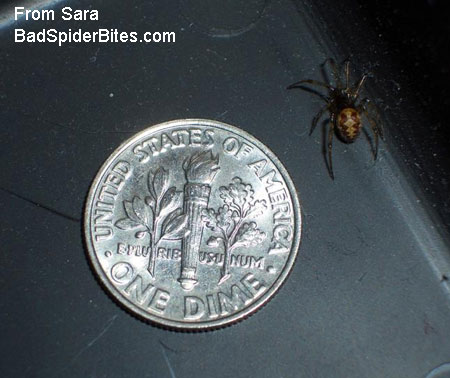
This is the spider the name was made for. Penn State Extension describes the common house spider, Parasteatoda tepidariorum, as a cosmopolitan species, extremely common in barns and houses, where it builds webs in the corners of walls, floor joists and windows, and most often met indoors in damp places such as basements and crawl spaces. The female is 5 to 6 millimeters long, about a quarter inch, with a yellowish-brown front half and a dirty-white to brown abdomen marked with gray chevrons, and yellow legs with darker rings at the end of each segment. Some have a triangular black spot on top of the abdomen. The male is smaller, under 5 millimeters, with orange legs. Missouri’s field guide sums the look up as drab: yellowish, tan, brown or gray with darker mottling, a round abdomen that is higher than long, and ringed legs. The web is a messy three-dimensional tangle, never a wheel.
Sara, in Boise, kept finding the spider above in the half-basement of her house: in the corner of the laundry room, climbing the shower door, or stuck in the sink. Another reader told her it was a common house spider, and the dime beside it says why the species is so easy to live with. One habit explains why there seem to be so many webs. Penn State says the spider frequently abandons its web to build a new one nearby, so one spider can leave many webs in a short time, which the extension page drily notes causes homeowners much grief.

Tracey, in Toronto, sent the photo above from under her stairs and asked what the little balls were, eggs or captured food. They are egg sacs. Penn State describes them as brown and ovoid with tough, papery covers, 6 to 9 millimeters across, each holding 140 to 380 eggs, and says a female may make twelve or more in her lifetime. Missouri describes the same sacs as teardrop-shaped, a globe with a point, often several in one web, with the spiderlings clustering nearby after they hatch. Males and females can be found at any time of year and share a web, and the spiders can live a year or more after maturing.
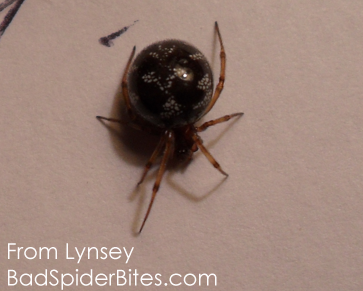
The common house spider belongs to the cobweb family, Theridiidae, and Missouri points out that this is the same family as the black widow, with more than 230 species north of Mexico. That is why a glossy, round-bodied cobweb spider deserves a second look. Lynsey found the one above under a kitchen shelf in Milwaukee, and a reader told her it looked like a house spider. The white speckling and reddish legs are not a widow’s marks. The way to be sure with any shiny black cobweb spider is the underside: the black widow carries a red hourglass there, and nothing else in your house does.
Giant House Spider and the Other Funnel Weavers
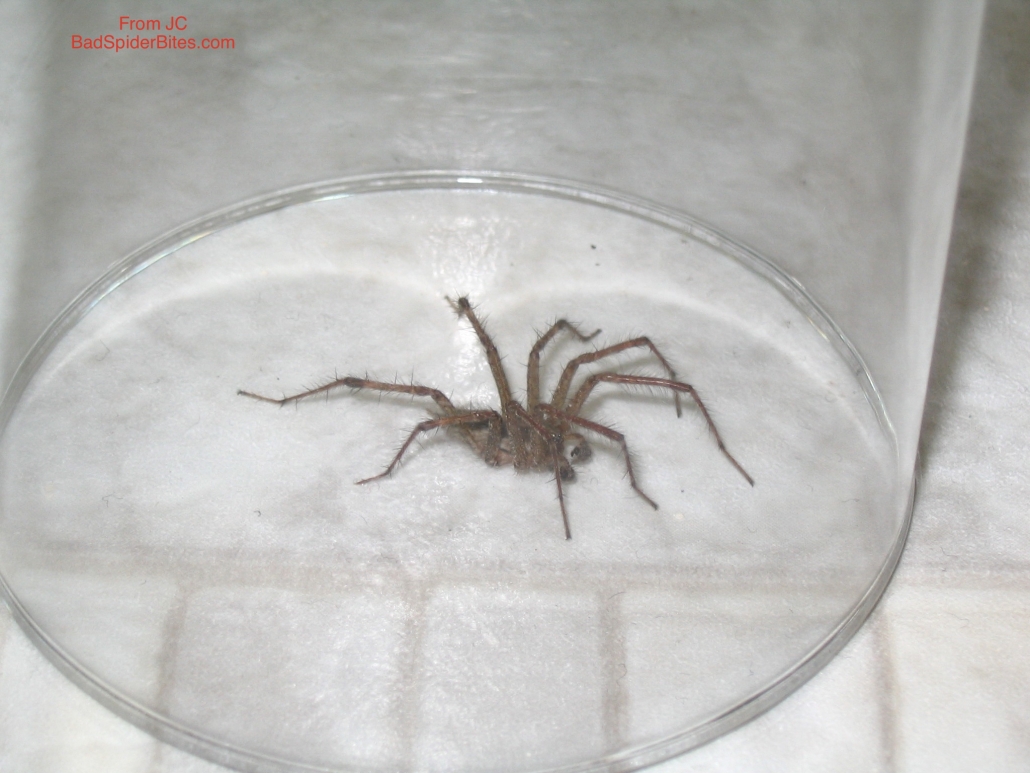
If your house spider is big, fast and hairy, with long legs and a flat sheet of web leading into a tunnel, it is a funnel weaver. Washington State University’s Pestsense describes the giant house spider, Eratigena atrica, as brown to grayish brown and highly variable, with a body of half an inch to an inch and a leg span that can reach four inches in large adults. It prefers dark places for its web and is, in the university’s words, ideally adapted to life indoors: garages and basements, and outdoors in firewood and gaps between bricks. It builds sheets of webbing with a funnel-like hole in the center where it sits. It is not much of a climber, so indoors it is usually found on the floor, or trapped in a sink or bathtub where it went looking for water. It is seen most in mid-summer to early fall, when the males are on the move. Washington State knows it from west of the Cascades, coastal Canada and Oregon, and it was introduced from Europe, where it is the house spider of British homes.
JC, in upstate New York, caught the spider above under a glass and worried it might be dangerous around a young son. It was the biggest spider he had seen indoors, and the long hairy legs, the pale stripes on the body and the two spinnerets poking out behind are the funnel weaver pattern. Ben found several of the same kind scurrying across the floor of his apartment and asked whether it was a funnel spider. It is.

The giant house spider matters for one more reason: it is the spider most often reported as a hobo spider. Washington State says the smaller males are often mistaken for hobos, that in the Puget Sound region giant house spiders outnumber hobo spiders and are met far more often, and that color, size and markings are not reliable for telling them apart. The Burke Museum goes further: a naked-eye view is simply not enough, the identification needs a microscope, around 200 other species in the region look similar, and the hobo spider is not a true house spider at all, because it cannot live permanently in buildings. Our hobo spider guide covers what is actually known about its bite. For the giant house spider, Washington State’s statement is plain: its bite is not known to pose any threat to humans, and the spider is not aggressive and runs away, very quickly, when startled.
Cellar Spiders: the Daddy Longlegs in the Basement
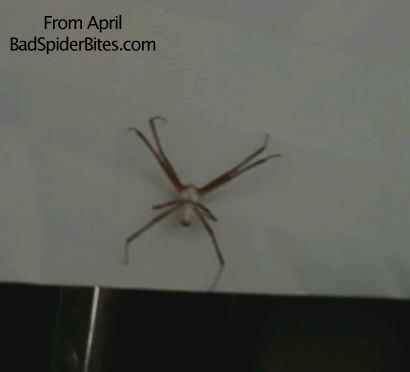
The wispy spider hanging upside down in a loose web in the cellar, the garage or the top corner of a room is a cellar spider, family Pholcidae. Missouri’s field guide describes them as inconspicuous, harmless and fragile, gray, tan or whitish, with bodies usually no more than about a quarter inch long on extremely long, thin legs, some with darkened joints that give a knobby-kneed look. Their signature is the vibrating: when alarmed they bounce so fast in the web that they blur. The web is a nonadhesive, messy cobweb in a corner or crevice. The commonest species in much of the world is the long-bodied cellar spider, Pholcus phalangioides, which the Australian Museum describes as a 9 millimeter spider with a brown patch on a pale carapace, found in most urban areas and especially houses, under furniture, behind doors, in ceiling corners, sheds and garages, feeding on insects and other spiders. April, in northwest Wisconsin, found the one above inside her car the morning after leaving the windows down all day, and said it was fast.
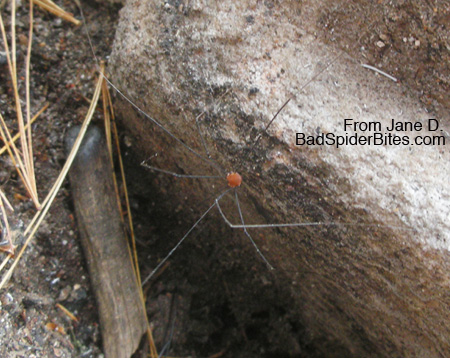
Two confusions follow this spider around. The first is the name. “Daddy longlegs” is also used for harvestmen, which are not spiders at all. Missouri notes that a harvestman has one apparently unified body where a spider has two clear parts, that it has no silk glands and cannot spin a web, and that it has no venom glands either. Jane, near Parry Sound, Ontario, photographed the beautiful creature below on a cold October morning, a single oval body on three-inch legs walking gracefully across the ground, and noted herself that it looked like one body, not two. It is a harvestman.
The second is the legend that the daddy longlegs has the deadliest venom of any spider but fangs too short to use it. The Australian Museum says there is no scientific evidence for it, that the venom is not that potent even for insects, and that the story probably grew from the spider’s habit of killing and eating redback spiders. The fangs, about a quarter of a millimeter, were shown on a television program to be able to pierce skin, but the stinging was very short-lived, and the museum says the species would never be considered harmful to humans. UC IPM says the same of cellar and house spiders generally: they are only marginally capable of biting people, because their fangs are too short to pierce skin in most cases.
Southern House Spider: the One Mistaken for a Recluse
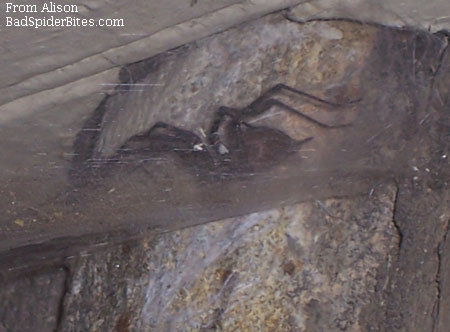
Across the southern United States the spider in the shutters and window sills is the southern house spider, Kukulcania hibernalis. The University of Florida’s Featured Creatures profile calls it conspicuous for its size and its distinctive flat, tangled web, common throughout Florida and much of the South in populated areas. The female is charcoal gray, 13 to 19 millimeters, half to three quarters of an inch, with an elongated oval abdomen. She picks a sheltered crevice in masonry, a window sill, a shutter or an overhang for a nest and spreads a woolly, unsticky web across the surface around it, which snags insects by its texture, in the way of velcro, and gathers debris and the body parts of prey until it looks unkempt. She hides in the crevice by day and sits out on the web at night. Females can live up to eight years.
Alison, in western North Carolina, had one large and in charge of her front door, with a web she described as super strong, like a big net. The flat sheet spreading from a gap in the stonework in her photo is the pattern the Florida profile describes.
The male is the problem child. He is 9 to 10 millimeters, khaki to amber, with long slender legs and long palps, and he builds no web but wanders looking for females, which is how he ends up on a bedroom wall looking, to a worried eye, like a brown recluse. Florida’s profile says males are often mistaken for the recluse because of their color and shape. The tells it gives: the male southern house spider is generally larger, has much longer legs and palps, and has eight eyes grouped on a raised bump, where the recluse has six eyes in three pairs and a violin mark that is wider and runs to the back edge of the carapace. On bites, the profile says the species is not known to have a dangerous bite, and that two reported cases caused pain and swelling for up to two days.
Black House Spider: the Window Spider of Australia
Readers in Australia send in a different animal under the house spider name. The Australian Museum’s black house spider, Badumna insignis, is a dark, heavily built spider, females 12 to 18 millimeters and males 9 to 15, with a dark brown to black carapace and legs and a charcoal-gray abdomen with a pattern of white marks. It is common in urban areas and so often builds around window frames that it is also called the window spider. The web is a lacy sheet with one or more funnel-like entrances to a retreat in a crevice, which the museum notes gets mistaken for a funnel-web spider’s lair, although the two are unrelated and look nothing alike. Around houses it eats the moths, beetles and termites drawn to lit windows at night, the female never leaves her web unless forced, and the spiders live about two years.
The museum’s bite statement is the strongest on this page, so it belongs in full. Black house spiders are timid and bites are infrequent. The bite may be quite painful and cause local swelling, and nausea, vomiting, sweating and giddiness are occasionally recorded. In a few cases skin lesions have developed after multiple bites. A cold pack may relieve the pain, and medical attention is for symptoms that persist. Jack, whose five-year-old was bitten on the finger one evening by what he assumed was a black house spider, saw the pain, no fever or vomiting, and a blister that formed within an hour, and had her at the GP the next morning, which is the right order of events.
North American readers who search for a “black house spider” after seeing a dark spider indoors almost never have this species. A shiny black one with a round belly is a cobweb spider and needs the hourglass check above; a large dark hairy one on the floor is usually a wolf spider or a funnel weaver.
The Spider in the Bathtub
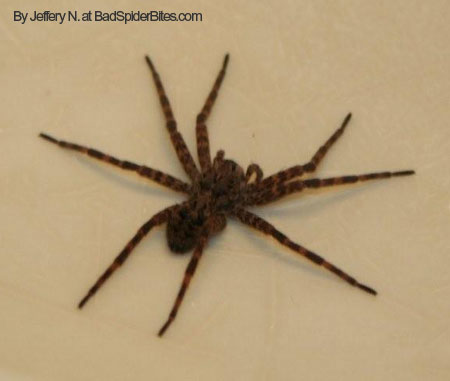
Jeffery, in northern Virginia, found the spider above in his bathroom sink one morning, about an inch and a half of brown fur, and trapped it in a container to ask what it was. He guessed wolf spider, and the striped back says he was right. It did not come up the drain. The Burke Museum knows of no case of a spider reaching a house through the plumbing; modern drains hold a water-filled trap that spiders cannot get through. What happens instead is that house spiders are thirsty creatures living in a very dry environment, and any that reach a sink or tub with water in it climb down the wall to drink, then cannot climb back up the slick sides unless a person lends them a hand. Washington State describes the giant house spider ending up in exactly the same place for the same reason. A cup over the spider, a card under it, and a trip to the garden ends the story.
The Big One Is Usually Not a House Spider
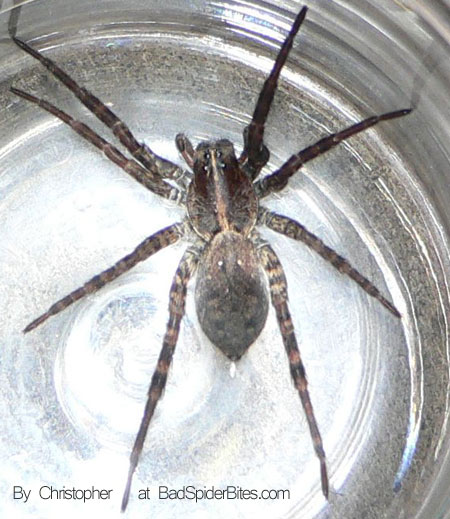
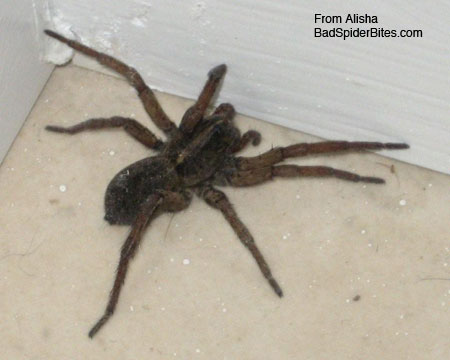
Christopher’s wife refused to park in the garage because the spider above turned toward the car as if to challenge it. He found it later under the garage door seal, caught it in a tumbler, measured it at about an inch and three quarters, and called it a large house spider. It is a wolf spider, which is the usual answer when the house spider is big, fast, furry and striped and has no web. Alisha, in Berks County, Pennsylvania, had five of the dark hairy spider below turn up in her house in two weeks and guessed barn funnel weaver, but the stocky build and the absence of a web point the same way. Wolf spiders hunt on the ground and wander in; they do not settle in. Both have their own page, the wolf spider guide, and so does the other visitor that gets the house spider label, the jumping spider on the window sill.
Do House Spiders Bite?
Rarely, and the record is thin because there is so little to record. Penn State’s verdict on the common house spider is that it is not regarded as medically important, and that given how many houses it lives in and how few bites appear in the literature, it is apparent that the house spider does not often bite people. The few recorded and verified bites brought pain that increased for an hour, a red mark or redness, and pain lasting 4 to 24 hours. Florida’s two southern house spider cases brought pain and swelling for up to two days. Washington State says the giant house spider’s bite is not known to pose any threat. UC IPM says cellar and house spiders are only marginally capable of biting at all. The one house spider on this page with a documented list of symptoms is the Australian black house spider, covered above.
UC IPM adds the sentence that matters most for anyone reading this page with a sore on their arm. Unlike mosquitoes, spiders do not seek people in order to bite them, and people and physicians often blame spiders for skin lesions with no proof a spider was involved. If nobody saw a spider bite you, and the mark is growing, hot, or oozing, the likelier causes are on our what bit me guide, and the spider bite pictures page shows what the mild bites readers have blamed on house spiders have looked like. First aid for a real bite is on the spider bite treatment page: wash it, cool it, watch it, and see a doctor for anything that worsens after a day or two.
Living With House Spiders
The university advice is consistent and undramatic. UC IPM says insecticides will not give long-term control and are not generally needed; seal cracks around windows and doors, keep screens in repair, keep clutter off the floor, vacuum webs and spiders, or capture a spider in a jar and release it outside, and use sticky traps where children and pets cannot reach them if you want to know what is walking your floors at night. Washington State says much the same for the giant house spider and adds the firewood rule: wear gloves, inspect each log, and bring in only what you will burn. Florida’s profile for the southern house spider says the spiders are there because insects are drawn to your lights, so screens and sealed gaps around pipes and wiring cut off both.
The Burke Museum’s point is the one to keep. Outdoor spiders that end up indoors die or at least do not reproduce, and the ones that live with you year-round are a handful of species that have done so for centuries, eating what comes in. A cobweb in a corner is a cobweb, not an invasion.
Where the Facts and Photos Come From
Species facts on this page are taken from Penn State Extension’s common house spider page, the Missouri Department of Conservation field guide entries for the common house spider and cellar spiders, Washington State University’s Pestsense fact sheet on the giant house spider, the University of Florida’s Featured Creatures profile of the southern house spider, the Australian Museum’s pages on the black house spider and the daddy-long-legs spider, UC IPM’s Pest Notes on spiders, and the Burke Museum’s spider myths pages. Where a source gives a measurement, a season or a bite record, this page repeats it and goes no further.
The reader photos and stories come from this site’s own identification thread and bite reports, collected from readers over more than a decade. Names are first names as the readers gave them, and the photos are theirs. Where a spider was identified by another reader rather than by an expert, or where the identification on this page is a judgment from the photo, the text says so. If you have a clearer photo of one of the species above, the spider identification guide is where readers compare notes.