Orb Weaver Spiders: The Big Web Builders in Your Yard
Every fall the same photo arrives at this site. A fat, round-bodied spider the size of a thumbnail or bigger, sitting head down in the middle of a wheel-shaped web strung across a porch, a window, a garden path or a doorway, with the question underneath: what is it, and is it dangerous? Most of the time it is an orb weaver, and the answer to the second question is no. This page shows you how to recognize the family, how to tell the common ones apart, what a bite from one means, and what readers have learned from living next to them.
Orb weavers are the spider family Araneidae, named for the orb, the round web. The University of Minnesota Extension describes them as small to large spiders, from an eighth of an inch to an inch in body length, in a wide variety of colors, commonly seen outdoors in gardens, fields and landscapes but rarely found indoors. Their web is the classic spider web of concentric circles and radiating lines. Penn State Extension notes that one orb weaver genus alone, Araneus, has about 1,500 species worldwide, which makes it the largest of all spider genera. So the exact species in your photo may never be settled, but the family almost always can be.
How to Tell an Orb Weaver From Everything Else
Three things identify the family, and you can check all three from a safe distance.
The web. A true orb web is a vertical wheel: spokes radiating from a hub, with a spiral laid across them. Funnel weavers build a flat sheet with a tube at one side, widows and the other cobweb spiders build an untidy tangle, and wolf spiders and jumping spiders build no web for catching prey at all. If the web is a wheel, you are looking at an orb weaver or one of its close relatives.
The body. Orb weavers carry a large, rounded abdomen that often dwarfs the front half of the spider. Readers describe it as a cherry tomato with legs or a fat yellow mushroom, and Missouri’s field guide calls the marbled one balloon-shaped. The legs are often banded, and on many species they carry small spines. The abdomen pattern on many species looks like a face, a leaf, a fir tree or a marbled swirl, which is where most of the folk names come from.
The habit. Most orb weavers either sit head down in the hub of the web or hide in a retreat to one side with a signal line running to the hub. Some of the commonest, the spotted orb weavers in particular, build at dusk and take the web down again by morning. The Missouri Department of Conservation describes the spotted orb weaver spinning a new web at dusk and eating the old one at dawn, and the Australian Museum describes its garden orb weavers constructing the web in the evening and taking it down at dawn. That is why a web that seemed to appear overnight across your porch really did.
The Orb Weaver Chart
| What you see | Which orb weaver | Where it turns up | Where to go next |
|---|---|---|---|
| Orange, yellow or white balloon abdomen with dark marbling, banded legs | Marbled orb weaver, the pumpkin spider | Moist woods, stream banks, tall weeds; mid-summer to the first hard freeze | Marbled section below |
| Brown abdomen with a white cross of spots near the front, sitting in the web by a porch light | Cross orb weaver | Pennsylvania to New England, Canada, Washington and Oregon; next to lit buildings | Cross section below |
| Brown or gray spider with a pattern like an upside-down spruce tree, out only at night under a light | Spotted orb weaver, also called the barn spider | Eaves of barns and houses, dusk-to-dawn lights | Spotted section below |
| Tan to brown with a dark zigzag-edged stripe down a shiny abdomen, web a few inches from a wall or window | Furrow orb weaver | Near ponds and lakes, under eaves and porches, bridges | Furrow section below |
| Large yellow and black spider with a thick zigzag band in a flat wheel web | Yellow garden spider (Argiope) | Gardens and fields in late summer | Garden spider guide |
| Long yellow body, golden web strung high between trees | Golden silk orb weaver, the banana spider | Covered on its own page | Banana spider guide |
| Bright silver belly, hanging under a flat web near water | Silver orb spider | Near water | Silver orb guide |
| Banded silver, yellow and black spider sitting with its legs in pairs on a web with a silk cross | St Andrew’s cross spider | Eastern Australia | Australian section below |
Marbled Orb Weaver: the Pumpkin Spider
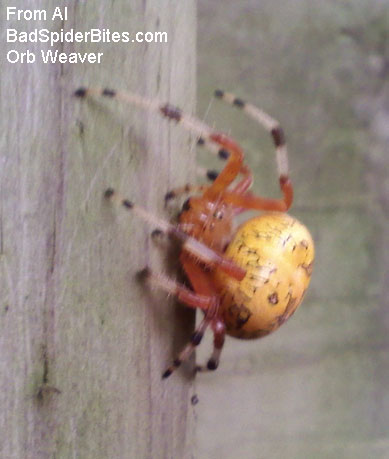
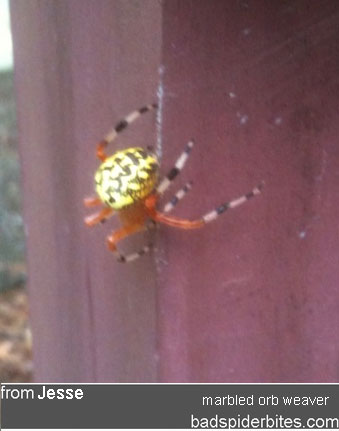
This is the orb weaver that gets photographed most, because it looks painted. Penn State Extension describes adult females as 9 to 20 millimeters long, roughly a third of an inch to three quarters, with very large abdomens that are mostly orange with brown to purple markings and spots of pale yellow. Occasionally the abdomen is nearly white. The leg segments nearest the body are orange, and the rest are yellow turning brown at the tips. The Missouri Department of Conservation adds that the pattern varies a great deal, from marbled swirls and furrows to fir-tree shapes, zigzags or a single big black spot, on a background of yellow, orange, tan, gray or white. The orange form, usually seen in fall, is the one called the pumpkin spider.
Al was raking leaves in his Maryland backyard when he found the spider above, bigger than a nickel, with what he called a fat yellow mushroom midsection and red legs that turned clear with black stripes. Jesse met one on a camping trip in the same state.
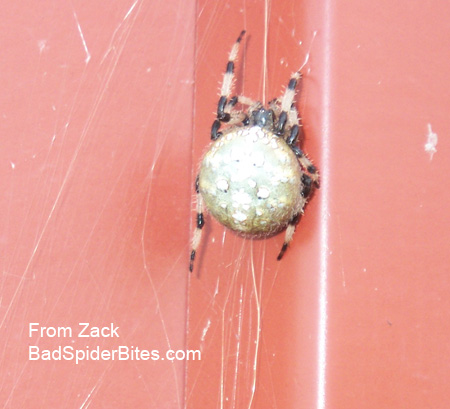
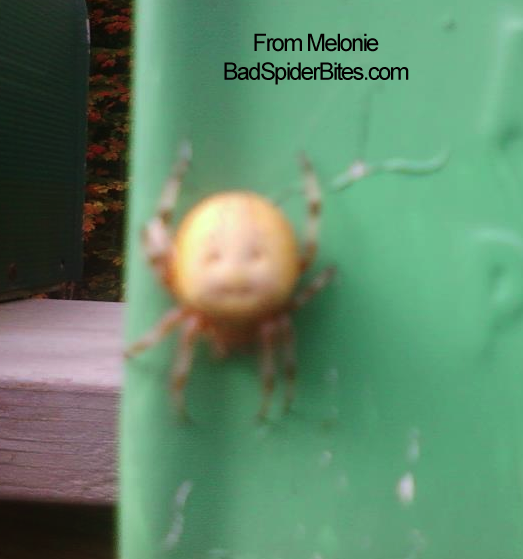
Zack found what looks like the white form on a barn near wooded land in Oregon, Illinois, one fall, and could not match it to the marbled photos online because of the color. Another reader suggested the shamrock orb weaver, a close relative in the same genus. Melonie, a rural letter carrier in Michigan’s Upper Peninsula, found one on a mailbox and had been told it was a pumpkin spider. Her photo shows why the marbling so often gets described as a face.
Where it lives and how it behaves: Penn State says the species is found across Canada to Alaska, through the northern Rockies, from North Dakota to Texas and east to the Atlantic. The web hangs vertically in trees, shrubs, tall weeds and grasses in moist, wooded settings, often along stream banks. Unlike the garden spiders, the marbled orb weaver does not sit in its web. It hides in a silken retreat to one side, at the end of a signal thread, and adults build that retreat from leaves folded over and held with silk. Missouri describes the same folded-over leaf, tacked shut with silk. Adults are seen from mid-summer until the first hard freeze. The egg sac, several hundred eggs in a flattened sphere of white silk, is usually laid in October, and the young emerge in spring.
On bites, Penn State is specific: a bite is unlikely unless someone handles a female with an egg sac in the web, and even then most people would feel no more discomfort than a wasp or bee sting. Minnesota’s extension puts it as extremely unlikely to bite people.
Cross Orb Weaver: the Spider by the Porch Light
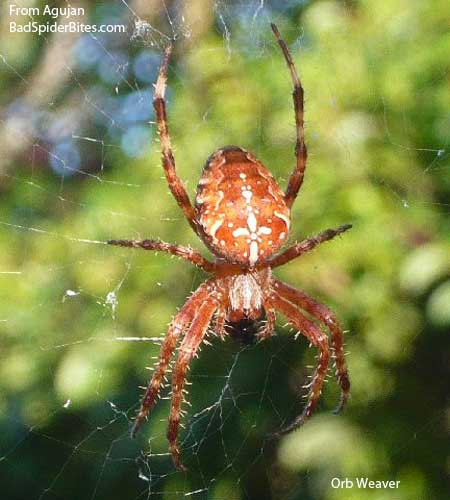
The cross orb weaver, Araneus diadematus, is the European garden spider, and in Penn State’s words it was probably introduced from Europe. Adult females run from 6.5 to 20 millimeters, males from 5.5 to 13. The background color is yellow to brown with two wavy or scalloped lines running the length of the abdomen, several white or yellow spots inside and around them, and four elongated spots toward the front that create what appears to be a cross. Smaller and younger spiders tend to be darker, adult females lighter. Penn State knows it from Pennsylvania north through New England and Canada, then south into Washington and Oregon, and says it is commonly encountered on or next to buildings with exterior lighting, including lit stairwells in rural areas.
Aglujan, near Santa Rosa in Sonoma County, called the spider above the Halloween spider because it was huge by the end of October. They lived only outdoors and in the open, never in dark corners, built a huge and very perfect web across walkways, in front of doors and in bushes, and sat in the middle of it. The photo is a textbook cross orb weaver, a little south of the range Penn State lists. Carrie’s mother in northern Maine had a dozen of what look like the same species outside her kitchen window, from smaller than a dime to the size of a cherry tomato with legs, all with what Carrie called a creepy smiley face on the back, in huge intricate webs under the eaves.
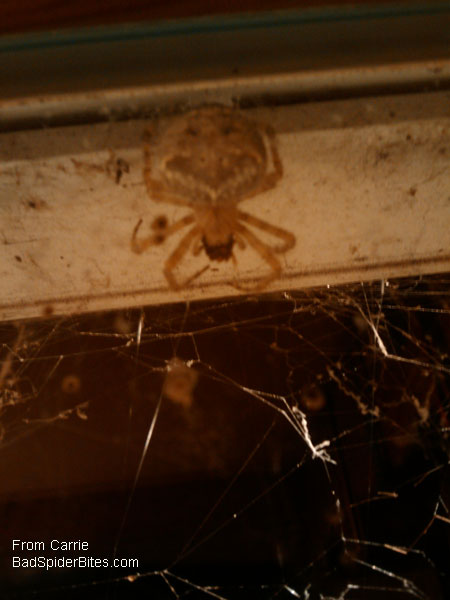
Adults are around from late summer through autumn. In late September the females leave the web to lay 300 to 900 eggs in a yellow silk cocoon in a protected spot, under the bark of dead trees or in cracks and crevices. The bite record for this species is the one real exception on this page, and it is worth stating plainly. Penn State reports that verified bites produce pain, swelling and redness, that some people also get anxiety, nausea, headache and muscle cramps, that not everyone reacts the same way, and that symptoms can last from two days to three weeks. That is still a bite you get by pressing the spider against your skin, and the first aid is the same as for any bite, but it is a reason not to handle them.
Spotted Orb Weavers: the Night Shift
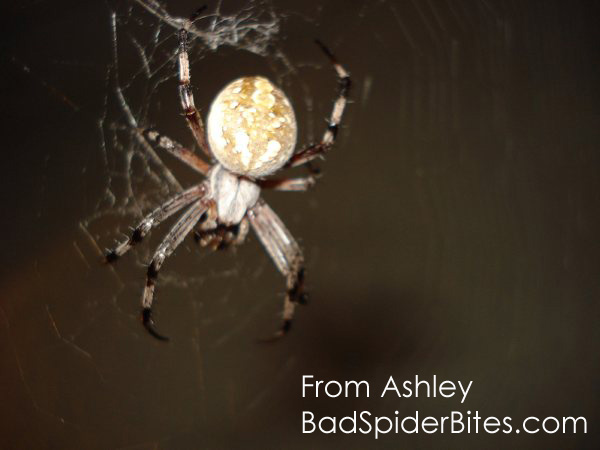
If the spider is only there after dark, under the light, in a web that was not there at lunchtime, it is most likely one of the spotted orb weavers, the genus Neoscona. Missouri’s field guide covers the commonest one, Neoscona crucifera, under three names: spotted orb weaver, arboreal orb weaver and barn spider. It is usually about half an inch long not counting the legs, with the males smaller, and carries a pattern on the abdomen that resembles an upside-down spruce tree in black, brown and greenish brown, with gray legs ringed in brown. It builds in woods and on the eaves of barns and houses, often near dusk-to-dawn lights. The female spins a new large round web at dusk, hunts through the night, and dismantles the web at dawn by eating it, then spends the day hidden in cracks and corners. Adults are commonly seen in late summer and early fall and die at the first freeze, with the young overwintering in the egg sacs. On bites, the guide says orb weavers do not bite unless molested, and that their bites are not dangerous anyway.
Ashley, across the street from an orchard near Fresno, watched hers every night by the outside light, catching the moths that circled it, and refused to kill what she called a beautiful spider. Chris, in northeast Florida, photographed a spider that built a web each evening and spent the day, or any bad weather, in a small nook under the eave. Darcy, near Sacramento, had one string a web three to four feet across her garden path and then hide among the tree leaves beside it. Her area has plenty of black widows, but the web was the wrong shape for one, and the spider had yellow spots on its back.
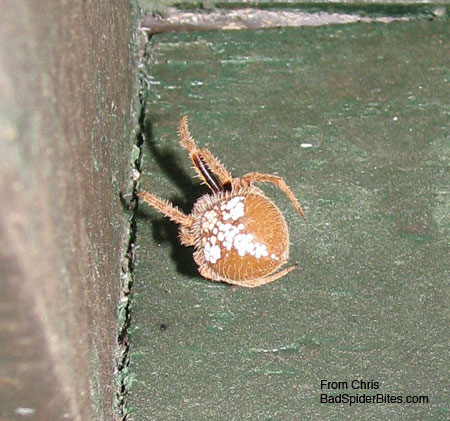
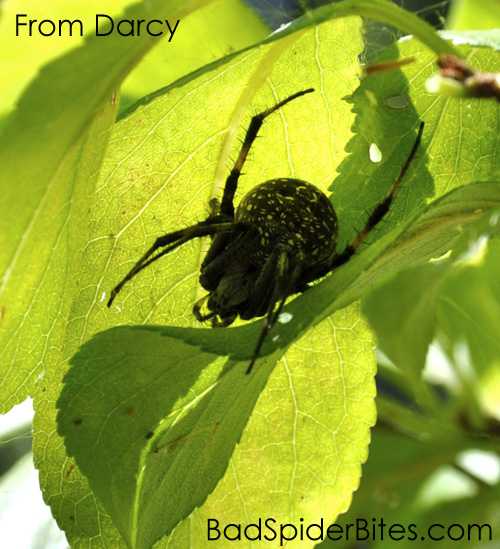
Craig, in Southern California, described the routine better than any field guide. Every evening for a couple of months, just before dark, large orb weavers dropped on single strands from his oak trees, anchored to the ground, built a big web, and then destroyed it and climbed back up before sunrise. He rarely saw them in daylight.
Furrow Orb Weaver: the One That Lives Through Winter

The furrow orb weaver, Larinioides cornutus, is the plain brown one you find by the pond, under the bridge, under the porch roof or next to the porch light. Missouri describes it as usually about half an inch long, with the male very close to the same size as the female, a smooth and rather shiny abdomen in tan, brown, gray, sometimes reddish or olive, and a dark zigzag-edged pattern running down its length that resembles the furrow a plow leaves, or a wavy-edged leaf. The legs are banded and carry small spines. The web is a wheel with the spiral circles spaced rather widely, and it is very often built parallel to a wall or window within a few inches of the surface, rebuilt or repaired in the late evening.
It is common in lowlands and low vegetation near ponds and lakes, on and under bridges, below the eaves of homes and under porches. Two things set it apart from the other orb weavers on this page. Most spiders die when freezing weather arrives in late fall, but Missouri says this species often survives the winter, so full-sized adults can be seen in spring, and they can live to be two years old. Missouri calls them harmless and credits them with reducing mosquitoes and other pests.
The Garden Spiders: Close Relatives With Their Own Page
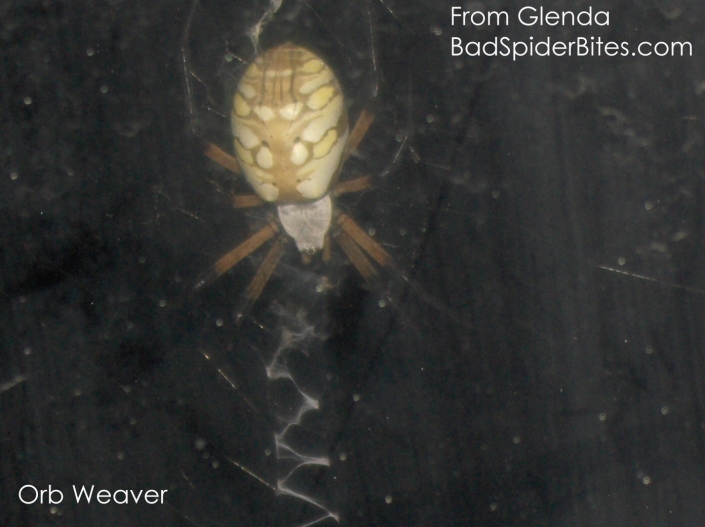
The biggest orb weavers in most American yards are the Argiope garden spiders, the yellow garden spider and the banded garden spider. Minnesota’s extension describes them as about an inch long in the body, several inches with the legs, found in late summer in the center of big, round, flat webs, and not dangerous to people. The thick white zigzag down the middle of the web is their signature. They have their own page here, the garden spider guide, so this page only covers how to tell them from the rest of the family: the Argiope sits out in the web rather than hiding in a retreat, and its web carries the zigzag.
Glenda watched the spider above grow bigger and bigger at her kitchen window and eat two grasshoppers in two days. Her husband said wolf spider. The zigzag under it says garden spider, and wolf spiders build no web at all.
One identification goes wrong on this site often enough to deserve its own paragraph. Readers in Kentucky and Texas were told by another reader that their black and yellow spider was a St Andrew’s cross spider, and Rick in Tulsa wondered the same about his, though he doubted it. He was right to. The Australian Museum, which describes that species, puts it in eastern Australia. A black and yellow spider with a zigzag web in a North American yard is almost always an Argiope garden spider, which is the American look-alike.
Orb Weavers in Australia

Two Australian species belong on this page because they are the ones that get mistaken for American spiders, and the other way around. The St Andrew’s cross spider, Argiope keyserlingi, is the one above: females 10 to 16 millimeters with a silvery carapace and a silver, yellow, red and black banded abdomen, males 3 to 4 millimeters and brown and cream. The Australian Museum describes it sitting with its legs in pairs on a medium-sized web occupied day and night in low shrubby vegetation, with zigzag ribbons of bluish-white silk forming a full or partial cross through the center. Threatened, it drops from the web or shakes it until spider and cross blur together.
The garden orb weavers of the genus Eriophora are the stout reddish-brown or gray ones with a leaf-shaped pattern on the abdomen, females 2 to 3 centimeters, with more than 100 known species across the country. The museum says the web goes up in the evening and comes down at dawn, and that by day the spider rests on nearby foliage with its legs drawn under its body. Its bite statement for orb weavers as a group is the clearest one in print: they are reluctant to bite, symptoms are usually negligible or mild local pain, numbness and swelling, nausea and dizziness can occasionally occur, and medical attention is for symptoms that persist.
Do Orb Weavers Bite, and Does It Matter?
Put the sources side by side and they agree. Missouri: orb weavers do not bite unless molested, and the bites are not dangerous. Minnesota: despite their large size and bright colors, orb weavers are not dangerous, and spiders in general very rarely bite people. Penn State on the marbled orb weaver: no worse than a wasp or bee sting for most people. The Australian Museum: reluctant to bite, with mild local symptoms. The one species with a documented range of stronger reactions is the cross orb weaver, covered above, and even there the trigger is handling. The federal page on venomous spiders for outdoor workers, from NIOSH, names two spiders of concern in the United States, the black widow and the brown recluse, and does not mention orb weavers at all. It also notes that spiders are usually not aggressive and that most bites happen because a spider is trapped or touched.
What matters more is the other half of Minnesota’s advice. Most people, and even doctors, over-diagnose spider bites, and the redness, swelling, pain and open sores that get blamed on spiders are usually caused by something else, bacterial skin infections included. Readers here prove that every season.
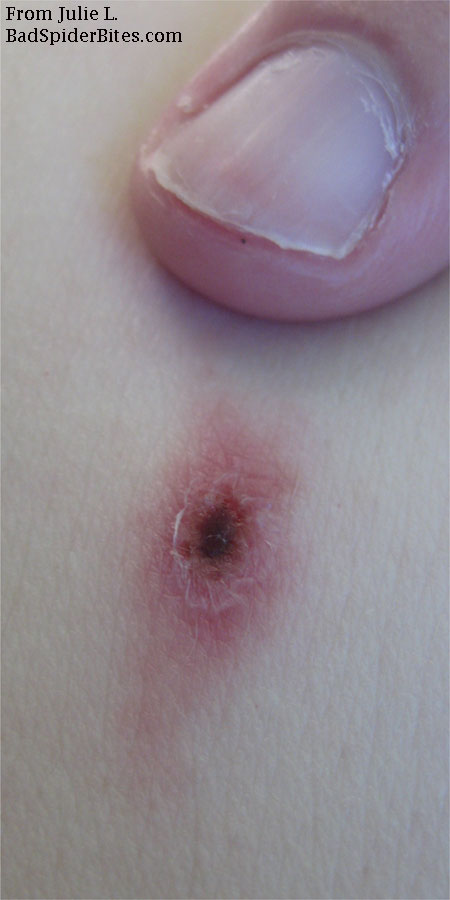
Julie and a friend hiked along a creek in Port Orchard, Washington, through what she described as orb weavers everywhere. Her friend came home with two bites, and a week later one had a black center and the other was changing color. Nobody saw what bit him, and the thread never recorded how it ended. A sore that keeps growing for a week and turns dark in the center is not what any source on this page describes for an orb weaver bite. It is the pattern covered on our what bit me guide and our staph infection page, and it is a same-day doctor visit whatever caused it.
If you are sure an orb weaver bit you, the spider bite treatment page covers the first aid, which is the same as for a sting: wash it, cool it, and watch it. See a doctor for a bite that gets worse after a day or two, for a red streak running from it, or for fever, cramping or trouble breathing.
Living With Them
An orb weaver on the porch is a mosquito and moth trap that costs nothing and leaves on its own. The adults of most species on this page die at the first hard freeze, and only the egg sacs carry over to spring. The furrow orb weaver is the one that may still be there in March.
Readers mostly reach the same conclusion once they know what they have. Hans, in Quincy, Massachusetts, did not want to kill his because he felt they were good for the garden. Rachel, in Colorado Springs, had a husband who would not let the kids or the cat outside until the spider by the back fence was named. Shawn’s doorway orb weaver, the one that hung six inches from his face one night, is told in full on the spider identification guide, and it ended the way most of these stories end: startling, harmless, and gone in a few days.
If the web is somewhere you cannot live with, move the spider rather than swatting it. Coax it into a jar in the evening when it is sitting in the hub and release it at the far end of the yard. Gloves and long sleeves when clearing brush or woodpiles prevent the one way most people get bitten, which is trapping a spider against skin.
Where the Facts and Photos Come From
Species facts on this page are taken from Penn State Extension’s marbled and cross orbweaver pages, the Missouri Department of Conservation field guide entries for the marbled, spotted and furrow orbweavers, the University of Minnesota Extension’s spider page, the Australian Museum’s pages on the St Andrew’s cross spider and garden orb weaving spiders, and the NIOSH page on venomous spiders. Where a source gives a measurement or a season, this page repeats it and goes no further.
The reader photos and stories come from this site’s own identification thread, which has collected spider photos from readers for more than a decade. Names are first names as the readers gave them, and the photos are theirs. Where a reader’s spider was identified by another reader rather than by an expert, the text says so. If you have an orb weaver story or a clearer photo of one of the species above, the identification guide is where readers compare notes.